

By Andreas Schleicher, OECD Director for Education and Skills
Walk into a classroom in the city of Guarulhos, and something subtle – but profound – has changed. The blackboard is still there. The teacher is still at the centre. The students still wrestle with fractions, verbs, and the mysteries of science. But behind the scenes, an invisible architecture is quietly reshaping everything. It’s called Sala do Futuro – and it’s not just another EdTech tool. It’s an attempt to build a new operating system for learning at scale.
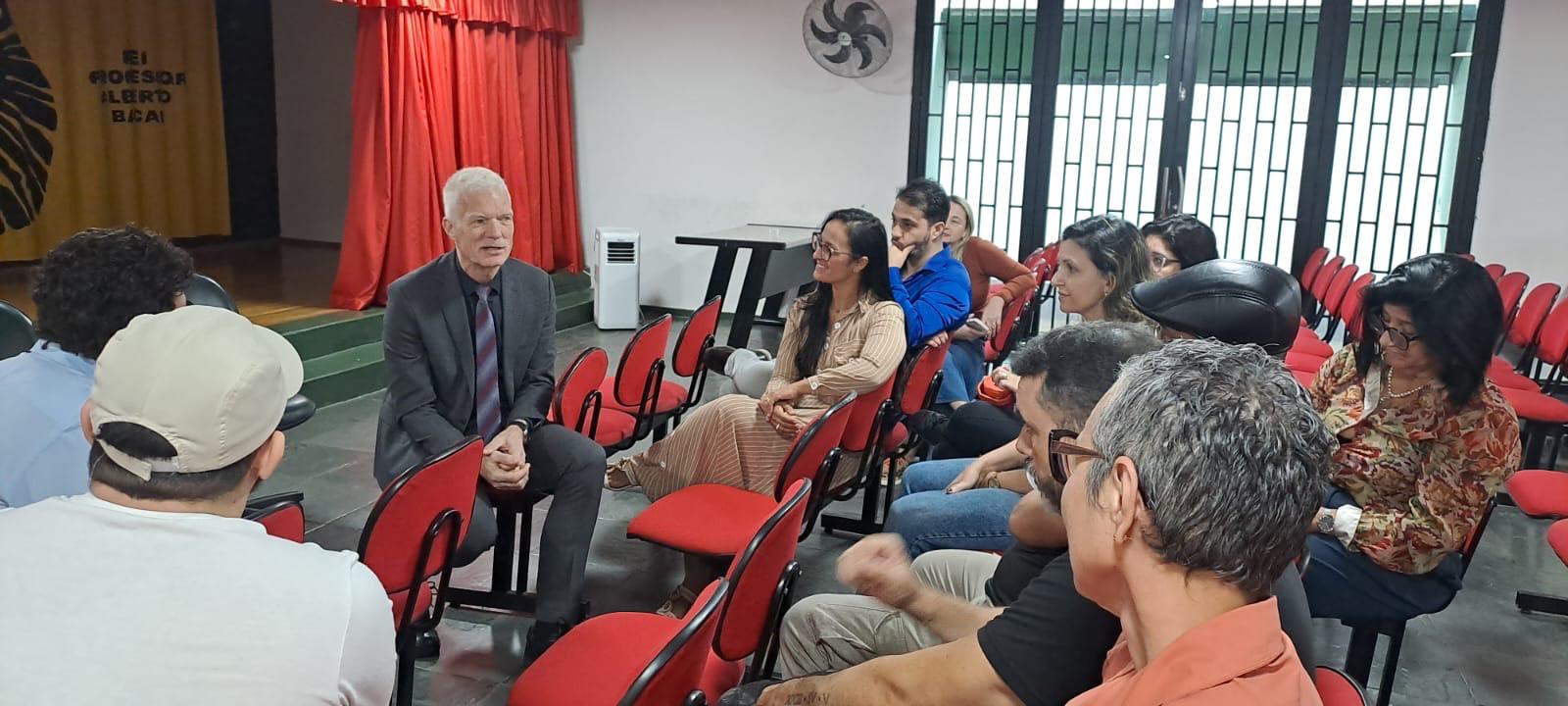
Maria Aparecida Nascimento – who steers education in the vast urban organism of Guarulhos – and principal Antonio Rafael da Costa warmly welcome me at the gates of Escola Estadual Alberto Lacan. It’s early, but the place is already humming. This is one of São Paulo’s extended-day schools, running in two shifts – 7am to 2pm, then 2:30pm to 9:30pm – like a city that never quite powers down.
Within minutes, I’m not a visitor anymore; I’m inside the current. The school runs on a different kind of energy – human energy. You can feel it in the corridors, in the classrooms, in the quiet and warm choreography between teachers and students. Here, teachers don’t just deliver content; they orbit their students as coaches, mentors, problem-solvers and social workers. They meet them where they are – and then move them forward.
It’s a culture of support that feels almost improbable when you step outside the gates. Because just beyond those school walls lies a different reality: a tough, under-resourced neighborhood on the edge of São Paulo/Guarulhos International Airport, Brazil’s busiest gateway to the world. Planes lift off every few minutes, carrying passengers to global opportunity. But for many of the students here, the runway to that world doesn’t begin at the airport. It begins in this school.
I take part in a mathematics class – and something unexpected happens. The room is alive. Not with noise, but with attention. Students are leaning in, working through the foundations of algebra – territory that, in many classrooms around the world, triggers disengagement faster than you can say “quadratic equation.” But not here. Because the teacher is doing something powerful: she is translating abstraction into relevance. She’s not just teaching algebra; she’s making it matter. And she’s not doing it alone. Behind her stands a system – São Paulo’s learning platform Sala do Futuro – quietly but systematically equipping her with rich, ready-to-use materials that bring the subject to life. Structure meets skill. System meets craft.
Most education systems think of digital platforms as libraries: places where content is stored, searched, and occasionally used. São Paulo flipped that idea on its head. This platform doesn’t just store content – it choreographs learning. Every lesson, every exercise, every homework task is part of a carefully curated flow: what students learn today, what they practice tonight and what teachers adjust tomorrow. It’s less like a textbook – and more like a score in an orchestra, where each part is timed, aligned, and connected.
At the heart of the system is a simple but radical idea: what if every teacher had access to structured lesson plans aligned with the curriculum, engaging video explanations, and ready-to-use exercises and assessments? For a novice teacher, this offers a launchpad. For an experienced one, it’s a resource bank. For the system, it’s a way to ensure that every classroom, in every neighbourhood, has access to the same high quality instructional backbone. The platform doesn’t replace teachers – it rewires the job. It shifts teachers from being content creators to becoming learning architects, curators of experience, translators of knowledge into meaning. Of course, the uncomfortable question hovers in the background: when does this kind of scaffolding stop being support and start becoming a crutch? When does it tip into dependency, into screen-bound teaching, into a narrowing of what pedagogy can be? The answer isn’t binary – it’s probably a matter of balance, and above all, of teacher expertise. But step inside Escola Alberto Lacan, and the teachers I met don’t see a loss of agency; they see a gain in possibility. For them, this isn’t about replacing teaching—it’s about reimagining what powerful teaching can look like.
I meet Gabriely, a senior high-school student from the afternoon shift with the quiet intensity of someone carrying more than just her backpack. Like many of her classmates in this corner of Guarulhos, school is only half her story. The other half is work – real work – to help keep her family afloat.
But here’s where the story bends in a different direction. At Escola Alberto Lacan, Gabriely isn’t pushed out into the informal economy, where too many young people trade their time for too little pay and even less future. Instead, the school pulls her in. It hires her – as a student mentor for the shift of younger students in the morning. It’s a small role, modestly paid. But it’s also something much bigger. With this mentor programme, São Paulo has engineered a new bridge inside its schools: students like Gabriely – positioned between the platform, teachers and students – translate, guide and support. Not as authority figures, but as near-peers who understand the terrain because they’re walking it too. And Gabriely walks it with purpose. She is still a learner, still building her own path – but now she is also a guide for others. She knows what it feels like to struggle, to juggle, to doubt. And that makes her credible in a way no textbook ever could.
In another version of this neighborhood, Gabriely might have been just another teenager absorbed into a cycle of low-wage work. Here, she becomes something else: a node of resilience inside the system. A signal that school is not just a place you pass through – it’s a place that can invest in you, even as you invest in others. It’s not a big salary. But it’s a different kind of currency: dignity, purpose, and a foothold in a future that doesn’t ask her to choose between learning and surviving. And it’s another important piece of the Sala do Futuro puzzle.
Then comes the second act: homework. Traditionally, homework is a black box. Teachers assign it. Students (maybe) complete it. Feedback comes later – if at all. In São Paulo, homework lives inside the platform – through Tarefa. And suddenly, it changes character. Homework is now automatically assigned and aligned with the day’s lesson, instantly corrected (for many tasks) and tracked in terms of completion, accuracy, and effort at school and system-levels.
For students, this means immediate feedback – the moment where learning actually happens. For teachers, it means visibility, who didn’t try, who tried but failed, and who is ready to move ahead. Homework is no longer peripheral. It becomes part of the core learning engine. Tarefa still offers loopholes, some students openly admit they plug in answers they obtain through WhatsApp groups rather than figuring the exercises out themselves, but most see the progress Tarefa presents to self-study in the past.
What ties everything together in this education system is data. Every click, every answer, every attempt feeds into a growing stream of information: at the student level, at the classroom level, and at the school and system level. This data is not just stored – it is visualized, interpreted, and acted upon, as I see later in the day in the office of Education Secretary Renato Feder.
Teachers see dashboards. Principals see trends. System leaders see patterns across thousands of schools. This system can ask – not in theory, but in real time: What is being learned? Where are the gaps? What needs to change tomorrow? It is governance through visibility.
In a system serving millions of students, the biggest challenge is not innovation – it’s coherence. Different schools teach different things, at different speeds, with different levels of quality. Sao Paolo has taken this head-on. By aligning curriculum, instruction, practice and assessment it creates a rare thing in education: a tightly coupled system. And that coherence can be powerful – especially for students in under-resourced schools, who usually suffer most from inconsistency.
What you see in Guarulhos is not a miracle – and that’s precisely the point. It’s something far more powerful: a system that has decided to get the basics right, at scale, and to do so with intention. Sala do Futuro is not a silver bullet; it’s a piece of infrastructure that changes what becomes possible. It doesn’t eliminate the need for great teaching; it makes great teaching more reachable, more consistent, more shareable. And in a world where inequality in education is often driven less by lack of ideas than by lack of execution, that shift matters. Because the real story here isn’t about technology – it’s about coherence, about connecting the dots between curriculum, teaching, practice and feedback so that every student, whether in the shadow of an international airport or in the heart of a global city, gets a fair chance to succeed.
