


By Andreas Schleicher, OECD Director for Education and Skills
Early childhood education and care (ECEC) is often hailed as the great equaliser which gives every child, regardless of their circumstances at birth, a fair start. Yet the reality across OECD countries is more complicated. While participation rates have risen, inequalities persist, and the way resources are allocated and structured may not match the needs of the most vulnerable.
Across most OECD countries, provision is split between publicly-run centres and private operators, both non-profit and for-profit. But there is sometimes a divergence in who these settings serve, where they operate, and the conditions they offer. In Chile, Colombia, Denmark, Finland, Israel, Spain, Sweden and Türkiye public management dominates, accounting for at least 60% of pre-primary settings. In Germany, the reverse is true: private providers hold sway. And in Ireland and New Zealand** all ECEC setting are privately managed. In Ireland, most are run for profit.
Private dominance is even more pronounced for children under age 3. According to TALIS Starting Strong data, in nearly all participating countries, more than half of settings for infants and toddlers are privately managed. For-profit models are common in Ireland, Israel, New Brunswick and Quebec (Canada) and New Zealand**, where they account for over 40% of provision.
This marketisation reflects many governments’ reliance on private operators to expand supply. It also raises questions about equity. In some countries and subnational entities, public settings dominate in the countryside, small towns and in “less favourable” neighbourhoods. Private settings, by contrast, cluster in urban and affluent areas.
This variability matters because disadvantaged children – those from low income families, minority language backgrounds or with special educational needs – stand to gain the most from high-quality provision. But paradoxically, they are often concentrated in settings with fewer resources and potentially lower quality environments. The result is a system that risks entrenching social divides from the earliest years.
Leaders of public ECEC centres in many systems frequently report poorer physical environments, such as ventilation, noise levels and space, than their private counterparts, according to TALIS Starting Strong data. In a few countries and subnational entities, private settings are more active in family engagement, a factor linked to better child outcomes. This is particularly the case for pre-primary settings in Colombia, Finland, Morocco, Norway, Spain and Türkiye.
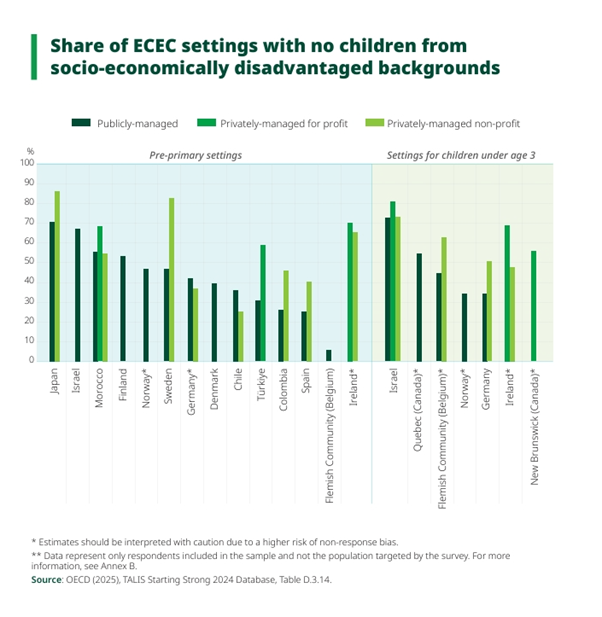
The divergence between public and private settings is particularly stark in some countries. In Türkiye, 59% of private for-profit ECEC settings have no children from socio-economically disadvantaged homes compared to 31% for public settings. Similarly, in Morocco, 68% of private settings serve no disadvantaged children versus 55% of public ones. In both countries, private providers offer more adequate physical spaces, indoors and outdoors, than their public counterparts. This divide shapes the experiences of millions of children from their early years.
There are notable exceptions. In the Flemish Community of Belgium for both levels of ECEC, private for-profit setting in Norway, and under-3 settings in Germany and Quebec (Canada), public and private provision look remarkably similar in distribution and some aspects of quality. In addition, in the Flemish Community of Belgium and Germany, the share of vulnerable children is broadly similar across public and private settings at both ECEC levels.
Governments face a delicate balancing act. Private provision expands supply and boosts participation, but without careful policy design, it risks entrenching inequality. Public ECEC centres need adequate resources to help them manage the more challenging circumstances they often face.
What should governments do? First, governments should invest in public ECEC settings so they can meet the complex needs of diverse populations, particularly vulnerable children. This includes allocating additional staff, training and materials to settings which serve high shares of disadvantaged children, where the impact of investment is greatest.
At the same time, private providers – many of which receive public funds – need close oversight. This is already happening in some places at the pre-primary level, where privately managed settings are more often subject to external inspections than public ones, particularly financial audits. In Türkiye, Spain and Finland, private settings also face stricter checks on structural quality, such as quality standards.
Funding should be tied to strict quality standards and transparency requirements, ensuring that money earmarked for education does not end up as shareholder dividends. Inclusion should also be incentivised, with subsidies or tax breaks for disadvantaged children enrolled in private ECEC settings or public funding made conditional to operating in less affluent areas.
These measures would help prevent inequality from deepening in mixed markets with both public and private ECEC provision. High-quality ECEC is a cost-effective way to reduce later spending on remedial schooling and social services. But achieving this requires strong governance and smart investment. Without taking action, the promise of levelling the playing field will be hard to truly achieve.
This blog is based on a chapter from the TALIS Starting Strong 2024 Insights and Interpretations brochure: talis3s2024-insights-interpretations.pdf.
The Starting Strong Teaching and Learning International Survey (TALIS Starting Strong) assesses the issues impacting early childhood education and care (ECEC). In 2024, it surveyed the ECEC workforce in under-3 settings and in pre-primary settings, which typically care for children aged 3-6, in a total of 17 countries and subnational entities.
