

By OECD Director for Education and Skills Andreas Schleicher
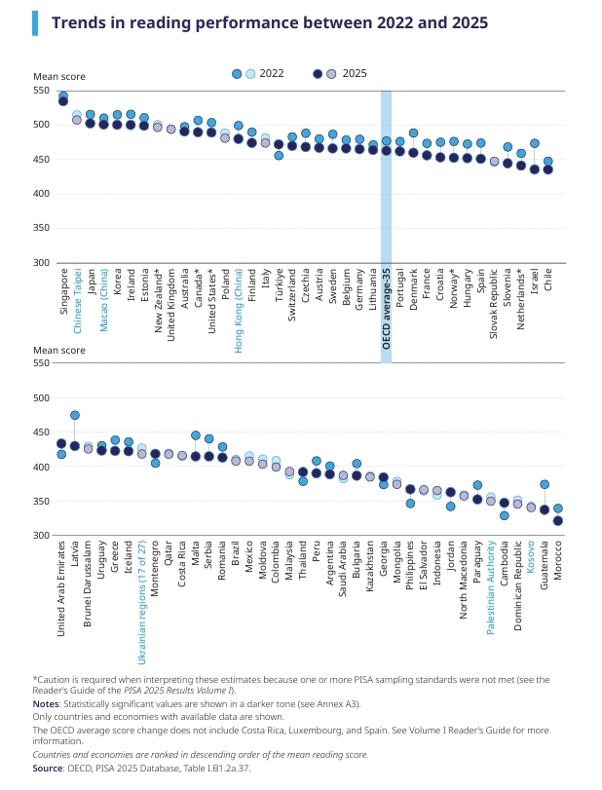
Out of all the results in the new Programme for International Student Assessment (PISA), global reading scores are the most concerning. Average reading performance declined significantly in three-quarters of education systems between 2018 and 2025 – 56 out of 74 with comparable data, to be exact. Across the OECD, reading scores fell by 25 score points on average, with Iceland and Slovenia seeing particularly large drops of over 50 points. Given that 20 score points is roughly equivalent to a year of learning, this implies that a majority of 15-year-old students across the OECD in 2025, on average, were performing at a level typically expected of 14-year-olds.
Only a handful of places bucked the trend and saw statistically significant improvements: Qatar (up 11 points), Brunei Darussalam (18), Cambodia (26), the Philippines (27) and Zambia (50). These education systems all remain below the OECD average but deserve recognition for achieving measurable gains despite the broader global decline.
Given the widespread collapse in reading scores, the results warrant closer inspection – particularly as reading ability is a crucial factor in how well students perform in other subjects. By examining student responses to different PISA tasks, it is possible to identify areas of specific performance decline. The data show that gender gaps in performance have remained relatively the same, as have the gaps between immigrant and non-immigrant students. But a large share of students struggled on reading tasks involving longer texts, requiring higher-order cognitive skills. These types of tasks demand careful reading, the ability to focus over an extended period and to integrate multiple pieces of information to form well-reasoned judgments.
At the same time, all students are more likely to “read in haste”, at least some of the time. This means they are more likely to rush through texts and give quick but incorrect answers. Between 2018 and 2025, the instances in which students read quickly but inaccurately nearly doubled to 9%. In three education systems – Kosovo, the Dominican Republic and Bulgaria – the rise exceeded 10 percentage points. Interestingly, students in all three systems report higher levels of digital distractions than the OECD average.
The rise in hasty readers, together with the decline in performance on more demanding reading tasks, is arguably easy to link to the growing shift towards digital reading. We cannot say for sure, but skimming social media feeds and rapidly processing information may be contributing to worsening ability and motivation to engage with complex texts and data. Since 2022, the share of students reporting that they spend more than one hour per day using digital devices to browse social networks has increased by almost six percentage points, according to PISA.
The impact of COVID and school closures is another explanation for at least some of the declines in performance. However, data suggest structural issues in education well before COVID. It is possible to compare the PISA data for 15-year-olds with another survey – PIRLS – which assessed mainly 9- to 10-year-old students in primary schools in 2016 and 2021. As many of the 2016 PIRLS students, for example, became eligible to take the PISA test in 2022, one can establish if there is a correlation. The analysis suggests that most of the falls in PISA reading scores were foreshadowed by falls observed in the PIRLS test at earlier ages. This suggests that at least part of the drops in reading skills can plausibly be linked to earlier childhood experiences, including learners’ home environment, early reading development and earlier schooling. In effect, the drops in reading scores are not just affecting teenagers; this worrying trend is already apparent in primary schools.
Analysis of the data highlights other correlations: Students across the OECD reported making less effort on the PISA test in 2025, compared to 2022 and 2018. Also, the share of students “curious about many different things” declined compared to 2022, particularly in education systems where reading scores declined the most. And countries and economies which saw relatively large increases in students who consider school a “waste of time” also saw large drops in reading performance. Such correlations are not proof of why reading scores have collapsed, but they are part of the context.
There is one other, perhaps surprising, finding buried in the PISA data concerning socio-economic status that is worth highlighting. Between 2018 and 2025, the most advantaged quarter of students saw the largest drops in performance. You read that right. It might be contrary to expectations, but students from relatively well-off families saw the biggest falls in reading ability. This suggests a new phenomenon, with the biggest factor in the overall drop in scores being advantaged students who are performing below what one would expect given their background. As a result, the socio-economic gap with the most disadvantaged students reduced by 11 points, on average across 35 OECD countries (from 88 score points in 2018 to 77 points in 2025).
How to sum up all this analysis? The negative trends in reading are pervasive and the drops in reading performance primarily reflect a decline in focus and attention. This leads us to a broader issue for policymakers, and for societies more generally: in an era of rapidly advancing artificial intelligence, the ability to read critically, assess the credibility of information, understand nuance and make informed judgments is likely to become even more valuable. The challenge for education systems, therefore, is how to re-engage young people with reading. In a world where many adults have also lost their love for reading, it is a challenge.
This blog is based on a chapter from the PISA 2025 Insights and Interpretations brochure:
