

By Andreas Schleicher, OECD Director for Education and Skills
At a time when technological innovation and interconnected global challenges are reshaping societies, one would hope that educational attainment is going up. The need for a highly educated and adaptable population has never been greater. But the new Programme for International Student Assessment (PISA) results show that progress in educational outcomes has been uneven. Learning outcomes have stagnated or declined in many countries, in some cases for well over a decade, and gaps in achievement persist across socioeconomic groups.
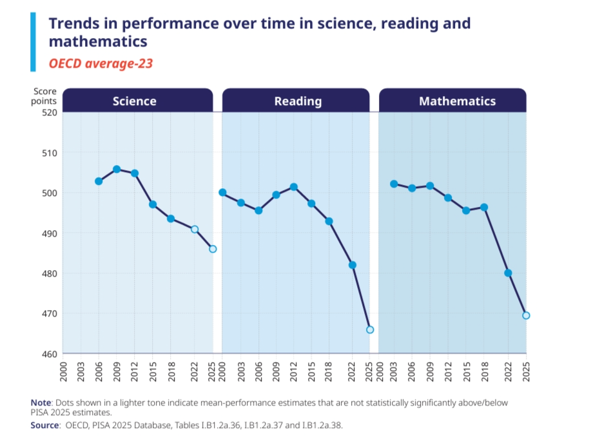
In science, the focus of the latest PISA assessment, results have been broadly stable. Between 2015 and 2025, OECD countries have seen a 7-point decline, on average, while other countries and economies held their ground. In mathematics, scores dropped by 22 points across the OECD on average, but only by 8 points for other education systems. Reading performance has seen the most significant decline: 28 points among OECD countries and 16 points among other countries and economies over the past decade. Interpreting changes in PISA scores is always complex, but 20 score points is roughly equivalent to a year of learning gains in any of these subjects.
Overall, some 29% of 15-year-olds in OECD countries are now estimated to be low performers across all three subjects, including students not covered by PISA – up from 25% in 2022. In science, this means they struggle to interpret simple data or identify evidence in a graph. In reading, they will find it hard to understand simple texts, while in maths they could have trouble deciphering the relationship between units and price – the kind of tasks embedded in everyday life, from grocery shopping to reading a utility bill.
Regarding the results in reading, it is particularly concerning that large and significant declines in success rates have been observed in reading tasks that are the most essential for today’s world of artificial intelligence: Skills such as evaluating information, reflecting critically and integrating multiple pieces of evidence, which require careful reading and sustained attention. By contrast, the instances of “hasty reading”, where students give fast and incorrect responses, have increased.
These trends are likely driven by a combination of factors. These include the changing nature of reading through digitalisation and screen use, which may be displacing time previously devoted to deeper reading; falling rates of reading for enjoyment, including among young people; and changing attitudes towards learning and school since the COVID-19 pandemic, possibly reflected in increasing levels of student absence in many countries, as some studies have suggested. The interaction of these factors has likely created a more challenging environment for reading and literacy development.
The steep declines in reading performance are particularly concerning as reading is the gateway through which most academic learning passes. Whether students are solving algebra problems, analysing a historical source or interpreting a science experiment, they must first understand language. The stronger a student’s reading ability, the easier it becomes to develop knowledge in every subject area. According to PISA, the education systems that experienced the biggest drops in reading also tended to see larger falls in maths and science performance.
Although the overall picture is gloomy, a closer look at the data reveals a more differentiated situation. Within the OECD, Costa Rica, the Slovak Republic, Türkiye and the United Kingdom have seen science scores go up since 2022. Among other countries and economies, improvements were seen in Cambodia, El Salvador, Georgia, Jordan, Mongolia, Montenegro, the Philippines, Saudi Arabia, Thailand, the United Arab Emirates, Uruguay and Uzbekistan. These are big achievements worth celebrating and a testament to the hard work of students, teachers, schools and policymakers.
Students in the Chinese jurisdictions of Beijing, Shanghai, Jiangsu and Zhejiang topped the PISA science test, achieving 597 points on average – over 100 points above the OECD average (482 points) – followed by Singapore (560), Macao (China) (541), Chinese Taipei (540) and Japan (538). Students at this level can tackle challenging scientific concepts and evaluate claims, spot errors and identify flaws in scientific arguments, making them prepared for some of tomorrow’s top jobs. All of these education systems are also top performers in maths and reading, with students in Beijing, Shanghai, Jiangsu, Zhejiang and Singapore achieving the highest scores on average.
Another measure of educational success highlighted in PISA is the score gap that separates the highest- and lowest-achieving students within a country or economy. The data show that while the highest achieving students’ scores have remained largely stable in science, lower achieving students are often doing worse than they were 20 years ago. Across education systems, the gap between low- and high-performing students is now the largest ever recorded by PISA, across all subjects.
In science, the gap widened by more than 15 score points on average across OECD countries between 2018 and 2025. Luxembourg and the United States* see the biggest differences, with over 290 score points separating top and bottom performers in science, indicating highly unequal learning outcomes. Similar patterns are seen in reading and mathematics in many countries. The data suggest that many education systems are becoming less successful at supporting all learners, with a rising share of students struggling to achieve even the most basic levels of proficiency.
However, this is not true everywhere. Over the past decade, five education systems – Türkiye, the United Arab Emirates, Montenegro, Qatar and the Slovak Republic – have simultaneously reduced their share of low-performing students, while increasing their share of top performers. Seven other countries and economies have also reduced their share of low-performing students. In addition, Chinese Taipei, Colombia, Korea, Luxembourg, Macao (China), Romania and the United States* increased their share of top performers.
The data reveal other forms of educational success. In Iceland, Cambodia and Finland, for example, there is very little variation in performance between schools, with school-level differences accounting for less than 10% of the overall variation in student achievement. This means schools are serving a broad mix of students across the achievement spectrum.
In contrast, in 10 countries – Bulgaria, Germany, Mauritius, Netherlands*, Romania, the Slovak Republic, Slovenia, Türkiye, the United Arab Emirates and Zambia – differences between schools account for at least 50% of the total variation in performance. This suggests many schools may only be accessible to higher-achieving students, while other schools enrol disproportionately large numbers of lower-achieving students. Where such academic segmentation compounds with social background, it can amplify inequalities, producing pockets of excellence while failing to ensure consistent learning outcomes across the education system as a whole.
Why is educational performance falling globally overall? The data do not give us the answer, but many would argue that the fallout from the COVID-19 pandemic in 2020 and subsequent widespread school closures cannot be ignored. However, OECD analysis suggests that there is no simple relationship between the duration of closures and subsequent reading trends. Plus, educational performance was already trending downward in many countries long before the pandemic struck.
The long-term declines in performance suggest deeper structural issues within education systems, with challenges at the school and system level. These include changing attitudes towards reading, the impact of digital distractions on students and rising levels of absenteeism.
Overall, the data suggest weaknesses in how education systems are adapting to social, technological and economic change. Looking ahead, the challenge for policymakers is not simply recovering lost ground, but to ensure schools meet the rapidly changing demands of the world. As PISA shows, it is not an easy task.
This blog is based on a chapter from the PISA 2025 Insights and Interpretations brochure:
