

By Andreas Schleicher
One way to see the fabric and true face of a society is to learn how it responds to a crisis. Nature can destroy anything mankind built within seconds, but human strength of mind, local initiative, and the joint forces of people can overcome seemingly unsurmountable challenges.
On 1 January, the day the world was celebrating the New Year, the Noto Peninsula in Japan was hit by an earthquake of magnitude 7.6. Driving for hours along the coastline through endless areas with collapsed houses, I could see some ruins marked with circles and red crosses, signalling where people had lost not just their homes but also their loved ones.
But I was equally struck by how strong societal foundations and resilient communities can face such challenges. Many wondered how Japan could maintain its strong educational performance in PISA during the years of the pandemic, when much of the world saw a sharp decline in student learning outcomes. The visit to Noto Peninsula helped me understand this better. Japan is a country of natural disasters, but it is also a country of extraordinary resilience. While many people have left the Noto region in the wake of the earthquake, accelerating its depopulation due to demographic shifts, teachers and school leaders have stayed. Within hours after the earthquake, they set out to find their students and families to ensure they were safe, and as soon as conditions allowed, they began to resume teaching at school. For students who cannot yet return to school due to damaged roads and infrastructure, they offer hybrid lessons, leaving no one behind.
Even in normal times, Japan is a country where there seems no boundary between the public and private lives of teachers. This is a country where teachers don’t just teach, but where they assume the roles of mentors, of coaches and of social workers too, roles that Western countries typically outsource to other professionals or services. What this means is that Japanese teachers know who their students are and who they want to become, and they accompany them and their families in good and difficult times. The Japanese teachers I met were not just great instructors but also passionate, compassionate and thoughtful people; they shared a deep belief that every student can learn; they promotes tolerance and social cohesion; they ensured that students feel valued and included; and they took a genuine interest in their students’ welfare and future. All this helps to explain why students from all social backgrounds in Japan excel in education. In the face of a natural disaster, this makes all the difference.
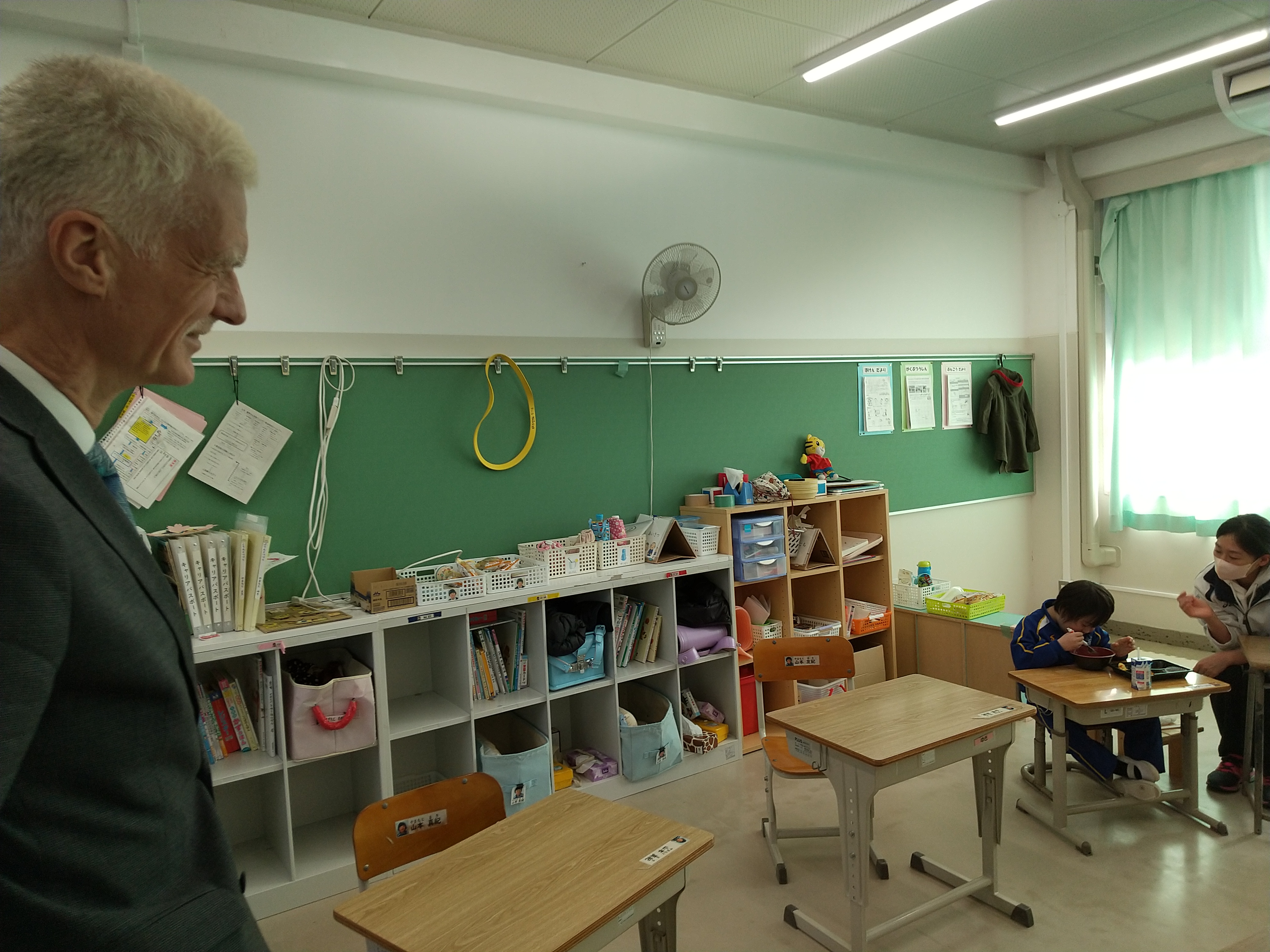
The crisis amplified the demands on teachers, with teachers taking on an incredible amount of additional responsibility with little material and psychological support. Like many other places in the peninsula, the school for students with special needs that I visited had still no running water, and it was up to teachers to do whatever it takes to give these most vulnerable children a caring education, a home and food. They live up to this, as I could see in the cheerful faces of the children, and the beautiful paper flowers on the wall which the children created symbolise the spring that will, hopefully, arrive soon after this long and difficult winter.
Satoshi Hirano, principal of Wajima high school and a great example of local leadership, welcomes me in German, my own language, and then leads me through his school. Unlike the buildings around it, the school building survived. What looks like a miracle is actually the result of careful planning and resourceful engineering, in this country where education is always a priority and where educational facilities are built with foresight and the anticipation of natural disasters. But of the playground and surroundings of the school remained little more than fields of mud, now occupied by vehicles of the Self-Defense Forces serving the immediate needs of the population.
Principal Hirano sleeps in his office since his own house collapsed during the earthquake. He acknowledges the difficulties when asked, but his heart and mind are squarely focused on the well-being of his students and his teachers. He explains that it is often only when students return from temporary shelter to their original environment that they and their families are realising the full impact of the earthquake. For some it is their lost family members, relatives or neighbours. For many more it is the loss of their livelihoods, as a large share of the jobs have disappeared, and may have gone forever as the economy restructures and new and different jobs will be needed requiring new and different skillsets and thus placing additional demands on people for adjustment. There is no doubt that these scars of children and their families will shape the work and life of teachers until long after the towns and cities have been rebuilt.
Japan can be proud of its teachers who are taking on this challenge, who don’t just feel as educators but as nation builders. But they deserve better support. Superintendent Kazumi Hachisaki, whom I meet in her office at the Nanao City Board of Education, acknowledges the difficulties but can offer little tangible help. Her office lacks data on the whereabouts and needs of students and teachers.
How far can you stretch the dedication and resilience of teachers left largely on their own before the education systems cracks, too? When I listened to principal Hirano, with tears in his eyes but also full of determination to help create a new Japan, Tokyo seemed far, very far, away. He stood in sharp contrast to the Western stereotype of Japanese bureaucrats waiting for instructions from above. However, April, the time when teachers are allocated to schools, is just around the corner and he worries that teachers may leave the region and the profession.
Throughout Japan, teaching has lost some of its magic and attraction. The government tries to fix this through a reform package that includes raising teacher pay and teacher support. But what teachers are asking for most is better social recognition, a more manageable workload and better support. That view is also reinforced in my discussions with Kenichi Miyagishi and Yoshida Kimie from the Ishikawa Teachers Union. While money is an obvious extrinsic de-motivator – when salaries are inadequate teachers will leave their job – money is rarely an intrinsic motivator. What makes a job attractive is always a combination of the social status of the job, the contributions people feel they can make in the job, and the extent to which work is intellectually rewarding. When we look at countries that succeed to attract great people into teaching, we can see two factors that make them stand out: They put systems, structures and support in place that publicly elevate the standing of teachers. The basic principle is that every interaction that teachers have with their students and their students’ families, with their colleagues and with their communities builds and banks social capital. They organise the work of teachers such that they get to know their students well and that they play active roles in their communities. And teachers’ engagement with families and communities in these systems is always asset driven and never deficit driven, just focusing on troubleshooting. Where partnership with transparency becomes the paradigm of accountability, teachers win the trust of society and that’s the energy that elevates the public standing of teachers.
The second factor is about how the work of teachers is organised and the opportunities teachers have for professional growth. What we can learn from Japan here is that effective professional development is always continuous, that it includes practice and feedback, and that it provides adequate time for follow-up. Japanese teachers work together to improve the quality of the lessons they teach. Because the structure of the profession provides opportunities for teachers to move up a ladder of increasing prestige and responsibility, it also pays for a good teacher to become even better.
But those features are coming under pressure in Japan. The global trend towards commodifying education, where students are consumers of learning content, where teachers are seen as service providers and where parents act as clients is beginning to take hold in Japan, too, and tears apart a tradition where school was the centre of the community and a whole-of-society enterprise.
What impressed me most is that, even in this difficult context, principal Hirano and his teachers are looking beyond the horizon of this disaster. They don’t just want to build back better, they are committed to build forward differently to educate students for their future, rather than our past, and to revitalise this region suffering from depopulation and economic decline. They understand the limitations of an education system that has solely focused on academic success, in an age in which the kinds of things that are easy to teach and test have also become easy to digitise and automate. In response, the teachers and students of Wajima high school are collaborating to co-create new learning environments and participate in a project to design the recovery plan for the city.
And they always look outwards, not just upwards: Later in the week I meet principal Hirano and his students again in OECD’s Future of Education and 2030 online conference with teachers and students from Ukraine and Türkiye, sharing their experience with navigating education through natural and man-made disasters, but also in dialogue on what they can do to create a better world through education.
Finally, education in this region does not stop at school gates. Akihiro Kannoki, an inspiring volunteer who established and runs the local evacuation centre in Nanao city through an innovative public-private partnership, explains how he established study places right after he had secured sufficient food for everyone, transforming the community library into a vibrant space where students can study and follow online lessons with donated laptops.
Acknowledging that we don’t have the firemen, doctors and engineers that the Noto peninsula needs right now, I was struck by the similarity in the answers I received when I asked what the OECD can do to help. Virtually everyone said that they knew how to rebuild the public infrastructure, that they will work hard to support their schools and teachers, but they want to collaborate with OECD countries to build a future-oriented education system. An education system that shifts from reproducing educational content for school towards strengthening competencies for life; from education to serve the nation state towards education for citizenship in the local community, the Japanese society and the global community; from education for competition in exam hell towards strengthening deep understanding, social skills and social cohesion; and from education for situational values – I will do anything the situation allows me to do – to sustainable values that reconcile the present with the future. And so many conversations ended with, please, don’t forget us.
