


By Andreas Schleicher, OECD Director for Education and Skills
Despite efforts to strengthen education systems, each year many young adults leave school ill-prepared for the world of work. As countries grapple with the economic and social costs associated with unemployment and supporting adult learning, the case for preemptive actions grows stronger. Early childhood education and care (ECEC) may be a long-forgotten part of young adults’ lives, but those early years are crucial. If someone falls behind in their learning and development early on, they may never catch up.
That is just one of the reasons why the case for high-quality ECEC is so compelling. When early learning environments, particularly at home, fail to provide adequate support, children may start schooling already behind. Gaps in language, literacy and social skills can be difficult to close. It may seem like an exaggeration, but children who are not keeping up at age 6 sometimes never regain the lost ground. This impacts their educational journey, job prospects and can perpetuate cycles of poverty.
To avoid this scenario, it is important for policymakers to support the development of high-quality ECEC, which can have lasting positive effects, particularly for children from disadvantaged backgrounds. One key aspect is to promote child development practices that intentionally foster cognitive, emotional, social and physical development. For example, ECEC staff can plan activities that let children make their own choices and take the initiative, helping children develop cognitive skills and planning abilities. This can include a wide variety of tasks such as creating stories through role-play or choosing materials for art projects. Even very young children can be encouraged to make decisions, such as deciding how to organise their colouring crayons. Measuring items can also foster early mathematical thinking and help children explore concepts like size and quantity.
However, data from the new TALIS Starting Strong report show that these kinds of practices tend to be less frequently used, as they demand more time, preparation and training. As a result, more reactive strategies are more common, such as responding to play invitations or comforting upset children. These strategies remain important to a child’s development, but ECEC staff should also include more deliberate and intentional development practices.
Some strategies are widespread. For example, TALIS Starting Strong data show that supporting social and emotional development is very common across systems. At least 80% of staff across all pre-primary settings surveyed report encouraging sharing once a day or more, apart from Germany (61%), Japan (70%) and Morocco (72%). In Ireland, the share is a massive 97%.
Some intentional child development practices are also regularly used in certain places. For example, three-quarters of ECEC staff in pre-primary settings in Chile, settings for children under age 3 in the Flemish Community of Belgium, and both levels of ECEC in Ireland, intentionally organise space to facilitate exploration and play. Three-quarters of ECEC staff in Ireland also plan activities designed to allow children to take the initiative.
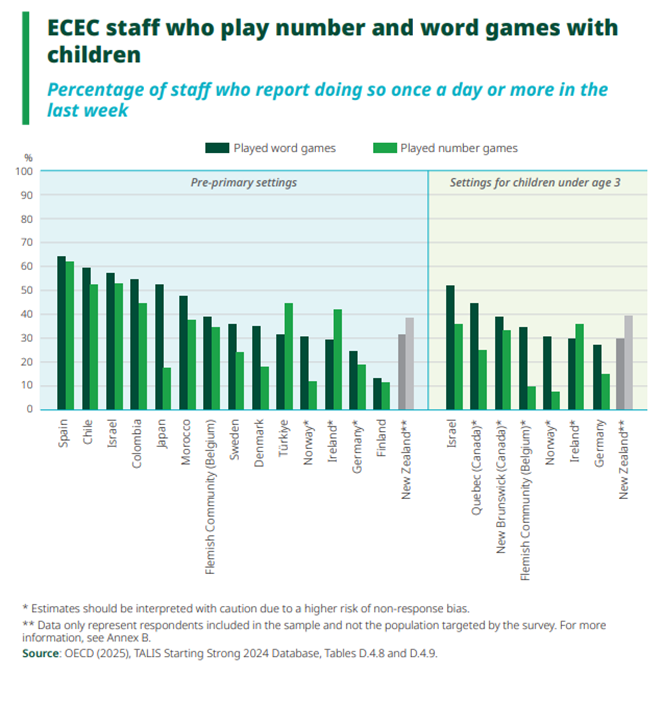
In contrast, in most places, intentionally supporting literacy and numeracy development tends to be less frequently used. In Spain, three-quarters of pre-primary staff report helping children to use numbers or to count once a day or more. But elsewhere, the share is far lower. For example, fewer than two-thirds of staff report doing so in most pre-primary and under-3 settings. In some countries the share drops to a third or less.
The data show that staff engage in literacy and numeracy practices more often if they can easily integrate them with other tasks, such as reading books or using maths concepts in everyday routines. This can be achieved in numerous ways, for example by talking about a sequence of activities and using words like “first” and “second”. Around three-quarters of pre-primary staff in the Flemish Community of Belgium and Spain speak about these kinds of maths concepts in their daily work with children. Similarly, over 80% of staff read books to children as part of their daily routines at both levels of ECEC in Ireland, and in under-3 settings New Brunswick (Canada).
Why does this matter? Children in high quality ECEC settings – where staff build positive relationships and provide strong learning opportunities – have higher levels of emerging literacy and numeracy skills, and stronger social skills. Children exposed to intentional child development practices build stronger foundations for success in school, emotional resilience and long-term wellbeing.
To achieve this, policymakers need to ensure staff have the time, training and support. Although on-going training is widespread in ECEC settings, job-embedded training – such as coaching, induction programmes and visits to other ECEC settings – is less common. For example, coaching, which is one of the most impactful forms of professional development, reaches fewer than 40% of staff in most systems. Participation drops below 20% in many places and only reaches around one in ten staff in pre-primary settings in Finland, Sweden and Türkiye and in settings for both levels of ECEC in Norway. Induction programmes to help prepare new staff are also under used. In Germany and Spain, fewer than 10% of ECEC staff participate in pre-primary settings.
To further support quality practice, policymakers should allocate protected time for training and reflection during working hours. ECEC staff must be treated as early educational professionals, not babysitters, and be given a solid grounding in child development and evidence-based pedagogical strategies. Strengthening leadership through targeted training and funding specialist roles can also help develop a culture of continuous improvement. By recognising and rewarding excellence, policymakers can encourage best practice and help attract and retain skilled ECEC professionals.
This blog is based on a chapter from the TALIS Starting Strong 2024 Insights and Interpretations brochure: talis3s2024-insights-interpretations.pdf.
The Starting Strong Teaching and Learning International Survey (TALIS Starting Strong) assesses the issues impacting early childhood education and care (ECEC). In 2024, it surveyed the ECEC workforce in under-3 settings and in pre-primary settings, which typically care for children aged 3-6, in a total of 17 countries and subnational entities.
