


By OECD Director for Education and Skills Andreas Schleicher
The arrival of generative artificial intelligence in classrooms has been swift and its impact immediate. Programme for International Student Assessment (PISA) data show that AI chatbots are now routinely used for schoolwork in many countries. More than 40% of students say they use AI to draft texts for writing assignments once or twice a week, or even every day, in Macao (China), Thailand, the Philippines, the Ukrainian regions (17 of 27), Saudi Arabia, Türkiye, Singapore, Mongolia and the United Arab Emirates (in ascending order). In Viet Nam, the share reaches 52%. These proportions are considerably higher if you include more sporadic use.
The findings will be of little surprise for many teachers. For a start, lots of teachers are already using AI to plan their lessons, increasing numbers are marking schoolwork with it, and many have noticed that student essays now arrive suspiciously polished, with homework on time and notably thorough. These developments have raised difficult questions about authorship, originality and the impact of AI on student outcomes.
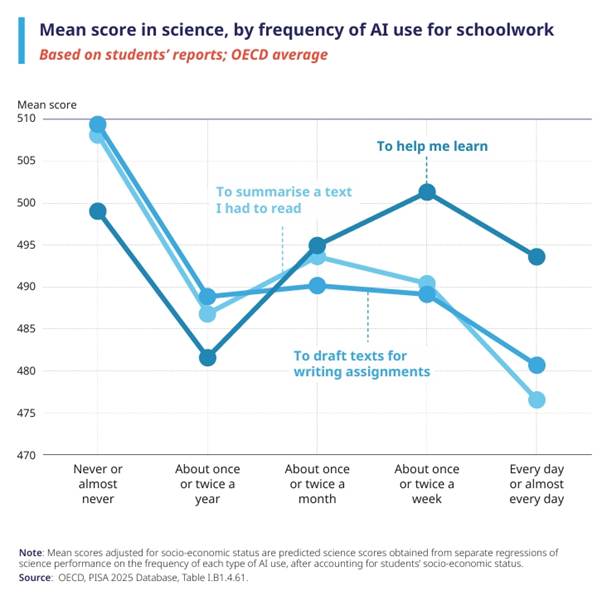
Is AI supporting student learning or not? PISA doesn’t give a definitive answer but, at first glance, the data isn’t positive. Students who report using AI chatbots get lower scores in science, on average, than those who don’t use AI. This includes using AI to summarise texts they had to read, conduct preliminary research on a new topic, or draft texts for writing assignments. In these scenarios, the students who don’t use AI outperform those who do, on average, by around 20 points – that is equivalent to being around one year of schooling ahead of their peers. In some countries, there is an even larger difference; students in Canada* and New Zealand* scored 29 and 36 fewer points, respectively, when they used AI chatbots to draft texts for writing assignments on a fairly regular or daily basis. Students who do not use AI chatbots for specific schoolwork tasks are also more likely to report higher levels of self-regulated help seeking, according to PISA data. All these findings do not necessarily represent a causal relationship. Lower performance outcomes could be linked to AI use or to other reasons, such as struggling students potentially being more likely to rely on AI.
The relationship between AI use and science performance is complex. For example, students using AI to draft text for writing assignments on a weekly or daily basis in Thailand and Macao (China) both saw significantly higher average scores (+24 and +21 points, respectively) than their classmates. In addition, the purpose and frequency of AI use appear to be important factors. For example, students who report using AI chatbots to help them learn once or twice a week perform at a similar level to students who report not using AI at all, on average across the OECD. This reflects the notion that digital tools can support learning when used purposefully and in moderation. In contrast, overuse or a lack of guidance can lead to distraction, limiting meaningful engagement and negatively affecting learning outcomes. Students who frequently use AI for learning – and learn to assess the quality of AI-generated information at school – also achieve slightly higher science performance than non- or infrequent users, according to PISA. However, advantaged students have greater access to these opportunities, which raises concerns about a potential AI divide.
The picture is further complicated when we look at the differences in AI use across high-performing systems. For example, students in Korea and Singapore are in the top tier for science scores and both countries have implemented large-scale, comprehensive policies to foster digital learning. In the case of Singapore, authorities have explicitly included the use of AI tools. In contrast, while students in Japan and Estonia perform at a high level in the PISA test, students’ use of AI for schoolwork is more limited in scope.
Overall, there isn’t one clear narrative, but the findings still raise some concerns. While the data is not proof of causality, proponents of AI have repeatedly argued that the technology can help improve student outcomes by providing personalised learning pathways, giving students instant feedback and support, and enabling teachers to identify learning gaps more quickly. But the evidence, so far, is less than clear cut.
‘Educational’ GenAI tools can lead to sustained learning gains, according to the OECD’s Digital Education Outlook, but ‘general-purpose’ GenAI tools often do not support deep learning. The reason? Researchers say the use of AI frequently leads to the offloading of cognitive tasks, creating a risk of “metacognitive laziness and disengagement”. It’s not exactly positive, is it?
Few countries would allow millions of children to receive a new vaccine without first conducting rigorous clinical trials and carefully evaluating the evidence. Yet in education, new technologies are often rolled out at scale with far less scrutiny. That may be the fundamental problem with edtech and AI in particular: we frequently experiment on groups of students before establishing whether a tool actually improves learning outcomes. The fact that AI exists and has catapulted itself into classrooms doesn’t mean we should ignore evidence suggesting potential harm. In the same way, the PISA data – at best – is a mixed bag. The bottom line seems to be that GenAI can support learning under certain conditions, yet frequently fails to do so in practice.
Going forward, governments and education authorities have an important role to play. Clear guidelines are needed on when, where and how AI should be used in schools, covering issues such as pedagogical value and appropriate classroom use, age-appropriateness, academic integrity, data privacy, transparency and bias. The OECD-EU AI Literacy Framework and OECD Insights on the effective use of generative AI in education are good starting points. Teachers also need substantial training and ongoing professional development to understand both the capabilities and limitations of AI bots. Without adequate support, educators risk either over-relying on AI or rejecting potentially useful applications altogether.
Most importantly, everyone in education – students, teachers, schools – needs to be aware of the limitations. Generative AI is an amplifier. Used well, some AI can explain, prompt, challenge and correct in a constructive way. Used poorly, it becomes a shortcut that bypasses the very cognitive work education is meant to develop. And if AI is used uncritically, this risks widening existing inequalities and creating new divides in the classroom. Until there is stronger evidence that AI is routinely resulting in positive outcomes, teachers and students should use with caution.

This blog is based on a chapter from the PISA 2025 Insights and Interpretations brochure
Note: An asterisk (*) by the name of a country or economy means that caution is required when interpreting these estimates because one or more PISA sampling standards were not met (see the Reader’s Guide of the PISA 2025 Results Volume I).
